
ℹ️ Portal informativo independiente. SepeFormate.com no es el SEPE ni está vinculado a ningún organismo público. No gestionamos solicitudes ni prestaciones. Trámites oficiales: sede.sepe.gob.es.
SEPE stands for Servicio Público de Empleo Estatal, Spain’s State Public Employment Service. If you are trying to understand unemployment benefits, find training or arrange an employment-related appointment, you will probably encounter its name. However, some of the services people casually call “SEPE” belong to a regional employment service instead.
The first distinction to understand is this: registering as a jobseeker and applying for an unemployment benefit are separate procedures. Completing one does not mean that every other step is finished. Knowing which organisation handles your request will help you choose the correct website, appointment and documents.
This guide is written for English speakers navigating the Spanish system. It explains the main routes, the Spanish terms you will see and a practical way to organise your next steps. It does not assess an individual claim or promise eligibility.
What does SEPE do?
SEPE is the national public employment body whose services include unemployment protection. It operates within a wider employment system that also involves the autonomous communities. That wider system covers employment support, guidance and training as well as the administration of unemployment protection.
Spain’s Employment Act, Law 3/2023, sets out the framework and the roles of public employment services. For a visitor trying to complete a task, the practical point is that a national framework does not mean a single office handles everything.
Start by describing the action you need rather than searching only for the name of an organisation. “I want to apply for unemployment benefit” is a different request from “I want to update my jobseeker registration” or “I need a training course”. An office may be able to explain the distinction, but choosing the correct service first avoids unnecessary appointments.
What this guide can help you decide
You should finish this article knowing which route to investigate, which questions to ask and what evidence to keep. You should not finish it assuming that a course advertisement proves eligibility or that an appointment confirmation is an award of benefits. Those outcomes require their own decisions and documents.
A useful starting question is: “What do I need the administration to do?” Write the answer in one sentence. You can then match it to the service descriptions below instead of opening several similar-looking forms and guessing.
SEPE and regional employment services: which one do you need?
SEPE’s official jobseeker-procedures page directs residents of autonomous communities to their corresponding employment service for registration-related procedures. It identifies Ceuta and Melilla as the exception, where SEPE handles these matters.
| Your objective | Starting point | What to check |
|---|---|---|
| Apply for an unemployment benefit | SEPE’s unemployment-protection services | The exact benefit and application requirements |
| Register or renew as a jobseeker | Your regional employment service; SEPE in Ceuta and Melilla | Your registration status and required procedure |
| Explore guidance or training | The relevant employment service and official training provider | The programme, audience and application channel |
| Arrange an office visit | The appointment service of the body handling your request | That the appointment category matches the task |
You may encounter regional names such as SAE in Andalucía, SOC in Catalunya or LABORA in the Comunitat Valenciana. The official regional-service directory is a better starting point than guessing a website address from an acronym.
Keep two separate entries in your notes if you need both registration and a benefit application. Under each one, write the responsible service, the action still required and the document that will confirm completion. This small organisational step can prevent a surprisingly common misunderstanding: “I have dealt with the employment office, so everything must be done.”
What changes if you are an English speaker in Spain?
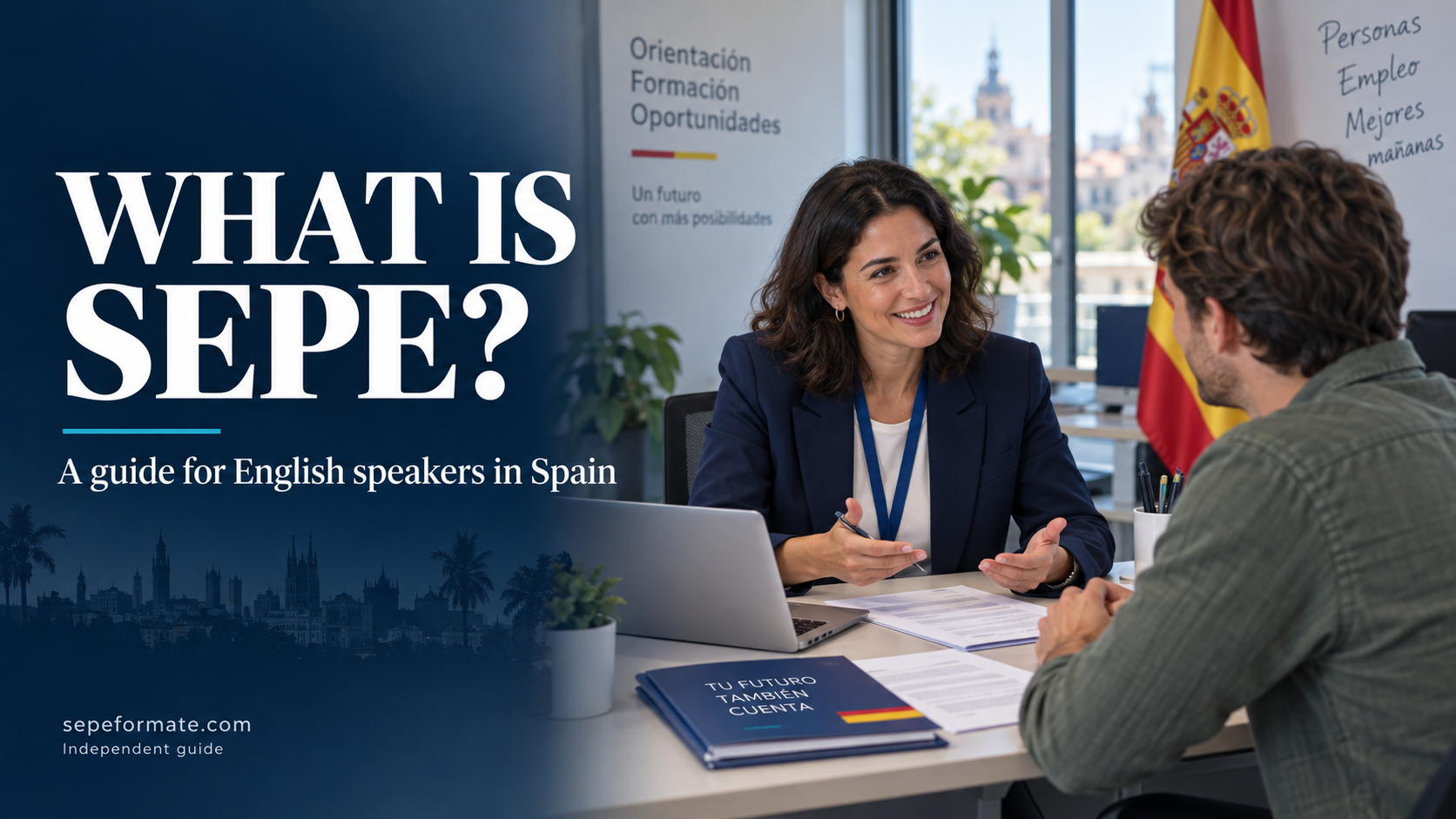
English is a language preference, not an eligibility category. An English-speaking reader might be a Spanish citizen, an EU citizen, a non-EU resident or someone whose working life spans several countries. Those situations cannot be treated as one group with one automatic entitlement.
Separate language support from the legal requirements
Prepare the Spanish name of the procedure you need, even if you prefer to discuss it in English. Before attending an appointment, ask what language assistance is available. This guide does not assume that an English-speaking adviser or an interpreter will be available at every office.
If you use a translation tool, preserve the original wording of official notices and forms. A useful personal note has three parts: the Spanish sentence, your English explanation and the action you believe it requires. If the meaning affects a deadline or entitlement, ask the responsible service to clarify it rather than relying only on an automated translation.
Check the registration rules that apply to your status
As a regional example, the SAE’s first-registration guidance distinguishes EU nationals from non-EU applicants, who need an administrative authorisation permitting registration. It also sets out residence requirements for its service. Use your own region’s guidance; this is not a universal document list for every applicant.
If you have worked in another country
The EU’s Your Europe guide to unemployment abroad explains that, in the situations it covers, the country responsible depends on work and residence circumstances rather than nationality alone. A U1 document may help establish previous periods of insurance or employment. It is not, by itself, a decision granting a Spanish benefit.
Make a simple work-history list before asking for help: countries, employers, dates and where you lived. That gives the adviser a clearer starting point than “I paid contributions abroad”. Do not assume that all foreign contributions are treated identically.
Your first steps: an organised approach
This is an editorial preparation checklist, not a substitute for the official procedure. Its purpose is to help you gather the right questions and avoid repeating work.
- Name the task. Choose a specific objective: register, renew, apply, report a change, check a decision or find training.
- Identify the responsible service. Use the official directory or procedure page. Save that address rather than a search-results page.
- Check the current instructions. Note the documents, access method and any deadline that applies to that particular procedure.
- Prepare your information. Gather the details actually requested, together with questions about anything you cannot provide.
- Complete the action and save evidence. Keep the confirmation, submitted documents and reference number where one is issued.
- Read subsequent communications. Record any outstanding action separately from the step you have already completed.
Use a small tracking sheet rather than relying on memory. Suggested columns are “task”, “service”, “date checked”, “next action” and “evidence saved”. Leave an item marked as pending until you have the relevant confirmation. A browser tab being open is not evidence that a form has been sent.
For preparation, you can read our guide to SEPE’s electronic office (in Spanish). The official instructions for your selected procedure remain the reference when you submit it.
Unemployment benefits: what should you understand first?
Prestación contributiva and subsidio por desempleo are different terms. Avoid treating every payment described informally as el paro as the same benefit. Identifying the exact scheme comes before comparing an amount or calculating a deadline.
The General Social Security Act, particularly Articles 266–269, sets out the contributory-benefit framework. It includes qualifying contributions, a legally recognised unemployment situation, jobseeker registration and other requirements. Having stopped work is not enough information to determine entitlement.
Why a general guide should not give you a personal payment estimate
Two readers may both say “my contract ended” while having different records and circumstances. A useful enquiry states the contract dates, what happened at the end and which benefit is being considered. It does not begin with an amount copied from somebody else’s claim.
Before contacting the service, write three questions: “Which benefit should I check?”, “Which requirement is unclear in my case?” and “What is the next formal step?” This keeps the conversation focused. If you receive an explanation you do not understand, ask for the name of the procedure and the official page that describes it.
Do not leave the deadline question until later
Article 268 addresses the application period and the effects of late submission. It also deals with paid annual leave that was not taken before employment ended, which can affect the starting point. Confirm the applicable deadline for your case promptly; do not copy one date calculation into every benefit procedure.
If an existing benefit is ending, treat the next step as a separate enquiry. Our guide to what to check when unemployment benefit ends (in Spanish) provides an orientation to possible routes. It does not mean that the next payment starts automatically.
Appointments, online access and Cl@ve
Use the official SEPE appointment page for a benefits-office visit. The page states that an appointment is required for that office service and also links to electronic alternatives.
It describes a registration-related automatic process for certain people who were registered as jobseekers within the preceding 180 days. It also gives instructions for people outside that situation or whose address has changed. Read the current notice and verify your status rather than assuming that everyone must follow the same first-registration sequence.
What to save when you book
Save the confirmation and check the office, date, time and purpose of the appointment. In your own notes, explain what you want to resolve during the visit. If you have two unrelated questions, identify them beforehand so that you can check whether they belong to the same service.
For a more detailed walkthrough, see our SEPE appointment guide (in Spanish). Keep the appointment confirmation separate from the receipt for any application you subsequently submit.
What is Cl@ve?
Cl@ve is an electronic identification system for interacting with Spanish public administrations. The official portal explains registration and its available identification methods. It is not an unemployment benefit and obtaining access does not establish entitlement to one.
Distinguish three stages when working online: identifying yourself, completing the form and finishing the required submission or signature step. Being able to log in only answers the first question. After sending a request, look for the confirmation provided by that procedure and keep it with your documents.
Where an alternative such as a presolicitud is offered, read what that route covers and what follow-up may be required. Select the route from the official page rather than assuming that any form with “SEPE” in its title is the appropriate application.
Prepare a document folder without assuming everything is compulsory
There is no single checklist that covers every registration, benefit and training application. The following table is a preparation aid. The applicable form or official request determines what you actually need to supply.
| Folder | What to prepare when relevant | Question to resolve |
|---|---|---|
| Identity and contact | The identity document and contact details accepted by the procedure | Do the name, identifier and address match my current records? |
| Employment | Dates and documents explaining the employment situation | What evidence does this application request? |
| Registration | Your jobseeker registration document or current status | Is any registration action still pending? |
| Application evidence | Receipts, reference numbers and official notices | What has been submitted and what remains unresolved? |
| Training | The course listing and any requested entry evidence | Am I applying to the correct intake and provider? |
Name files clearly, for example “appointment-confirmation” and “application-receipt”, followed by the date. Keep the original downloaded document as well as any personal translation. If you ask someone for help, explain which document they are reading rather than sending an unlabelled collection of screenshots.
A short question log can also help: the question, who answered, when and what you still need to check. Treat informal explanations as preparation; keep the actual official communication that governs your case.
What are “SEPE courses”, and where should you look?
The phrase “SEPE courses” is widely used in searches, but a course needs to be assessed through its actual programme and provider. Do not treat the phrase as a complete description of admission, language, funding or the qualification awarded.
FUNDAE’s worker-information page links to subsidised training, online learning and other training resources. It also directs readers towards employment services for guidance on training pathways. Use the official listing for the programme that interests you.
Five questions before applying
- Who is the course for? Find the stated participant profile rather than relying on the headline.
- Who receives the application? Record the organisation and official application link.
- What language is used? Check teaching, materials, assessments and support separately.
- What does completion provide? Ask for the exact name of the document or credential.
- What commitment is required? Compare the timetable, attendance and assessment with your availability.
An English-language explanation of a course is not evidence that the course itself is taught in English. A practical message to a provider is: “In which language are the lessons and assessments delivered, and where can I read the entry requirements for this intake?”
As another example of careful comparison, our AI training guide (in Spanish) distinguishes learning access from credentials and scholarships. It includes options beyond subsidised employment training; do not assume that every listed programme is a SEPE course.
Check the purpose of a certificate
Write down what you need the credential for before choosing a course. Learning a skill, satisfying an employer’s request and meeting a public recruitment requirement are different objectives. Ask the receiving organisation which evidence it accepts.
If your goal involves Spanish public recruitment, our guide to checking course merits in competitive examinations (in Spanish) explains why the specific call and scoring rules matter. A course’s marketing description cannot answer that question for every selection process.
Three illustrative situations
These examples are invented to explain a workflow. They are not testimonials, real case studies or decisions about anyone’s entitlement.
Example 1: an English-speaking worker whose contract has ended
Alex lives in Andalucía and wants to understand the next steps after a contract ends. Alex writes down two tasks: check jobseeker registration with the regional service and investigate a benefit application through SEPE. The first action is to read the relevant official instructions and establish the current registration status.
Alex then prepares the employment dates and questions about the claim deadline. The folder has separate spaces for registration evidence and the benefit application. This example does not establish that Alex qualifies. It shows how to avoid confusing two administrative tasks that arise at the same time.
Example 2: a resident looking for a digital-skills course
Priya wants to improve office skills and finds a course described in English. Before applying, Priya asks which language is used during teaching and assessment, who can join the intake and what completion document is issued.
Priya compares the official listing with the advertisement and saves the provider’s answer. The resulting decision is based on a suitable course and a workable timetable, not simply the presence of the word “free”. There is no assumed course place, scholarship or employment outcome.
Example 3: a worker with employment in two EU countries
Daniel has worked in Spain and another EU country. Instead of assuming nationality decides where to claim, Daniel prepares a timeline showing work and residence. Daniel asks the responsible service whether the overseas periods are relevant and whether a U1 document would help.
The useful result is a clear next question and an evidence request. This example deliberately does not calculate a payment or decide which country must pay: those conclusions require the actual circumstances and the applicable coordination rules.
Common problems: what to check next
| Problem | Useful next check | Avoid assuming |
|---|---|---|
| I cannot find an appointment | Read the official alternatives for the specific procedure and ask how to proceed if a deadline is near. | That an unavailable appointment page automatically completes or extends a claim. |
| I logged in but cannot find a receipt | Check whether the form reached its final submission stage. | That successful identification means successful filing. |
| The office says my request belongs elsewhere | Ask for the exact procedure name and responsible service. | That all services share the same booking route. |
| A translation is unclear | Keep the original sentence and ask about the specific action it requires. | That an approximate translation settles a legal question. |
| A course listing lacks key details | Request the intake, language, participant requirements and credential information. | That a broad promotional headline covers every applicant. |
When reporting a technical problem, write the date, the procedure name and the error message. Describe what happened before the error appeared. This makes the request easier to understand than “the website does not work”. Keep sensitive identity details out of public comments and send documents only through the appropriate channel.
Spanish–English glossary for your first SEPE visit
- Servicio Público de Empleo Estatal
- State Public Employment Service, commonly shortened to SEPE.
- Demanda de empleo
- Your jobseeker registration or employment-service record; not the same as a benefit application.
- Demandante de empleo
- A person registered as a jobseeker with the relevant employment service.
- Renovación de la demanda
- Renewal of jobseeker registration. Follow the instructions on your record.
- Cita previa
- An appointment arranged in advance.
- Prestación contributiva
- A contribution-based unemployment benefit subject to its legal conditions.
- Subsidio por desempleo
- An unemployment assistance benefit with the conditions of the specific scheme.
- Sede electrónica
- An administration’s official electronic office.
- Justificante or resguardo
- A confirmation or receipt. Check which action it confirms.
- Requerimiento
- An official request for an action, clarification or documents.
- Resolución
- The formal decision on a procedure.
Frequently asked questions
Is registering as unemployed the same as applying for benefits?
No. Registration and the benefit application are distinct. Check that you have completed the steps required for both when both are relevant to your situation.
Can I use an English guide even if the official form is Spanish?
Yes, as preparation. Keep the form’s original terms and use the official instructions when completing it. Ask for clarification if a translated word changes your understanding of a requirement.
Does an appointment mean that my benefit has been approved?
No. An appointment arranges attention. It is not the decision on your application. Keep the booking confirmation and any subsequent application receipt as separate documents.
Should I contact SEPE to renew my jobseeker registration?
Usually you should follow your regional employment service’s route. SEPE’s guidance identifies Ceuta and Melilla separately. Use the official directory and the instructions attached to your own registration.
Can every English-speaking foreign resident receive unemployment benefits?
That cannot be determined from language or foreign-resident status alone. The applicable scheme and individual circumstances need to be checked. Cross-border employment may introduce additional questions.
Are the courses explained here taught in English?
This article is in English; it does not certify the teaching language of any course. Confirm the language of lessons, assessments and support with the provider before applying.
What if I already receive a payment and want to report a change?
Identify the benefit and use its official change-reporting procedure. Prepare a clear description of what changed and when. Do not assume that editing a detail in an unrelated account updates every administrative record.
Can SepeFormate submit my claim or reserve a course place?
No. This is an independent information website. Use the responsible public service or the provider identified in the official course listing.
Choose one concrete next action
If you need a benefit, identify the exact procedure and check its requirements and deadline. If you need registration, find the responsible employment service and establish your current status. If you want training, choose a specific official listing and check its language, entry conditions and application route.
Before you close this guide, write down the service, the next action and the evidence you will keep. That gives you a practical starting point without confusing an enquiry, an appointment, a submitted application and a final decision.
🛡️ Guías de seguros para trabajadores y autónomos en España 2026
- 🛴 Seguro de patinete eléctrico obligatorio 2026 — desde 5€/mes
- 💼 RC para autónomos — deducible al 100% en IRPF
- 🏥 Sanitas vs Adeslas 2026 — cuál es mejor para ti
- ❤️ Seguro de vida hipoteca — ahorra hasta 500€/año
- 🐾 RC perro obligatorio 2026 — desde 30€/año
→ Ver todas las guías de seguros para trabajadores en España
